
AI scores 84.5% on drug chemistry and still misses the pick
AI can reconstruct molecules and explain experimental evidence well. Choosing which compound to make next, and predicting its properties, is still where models fall down.
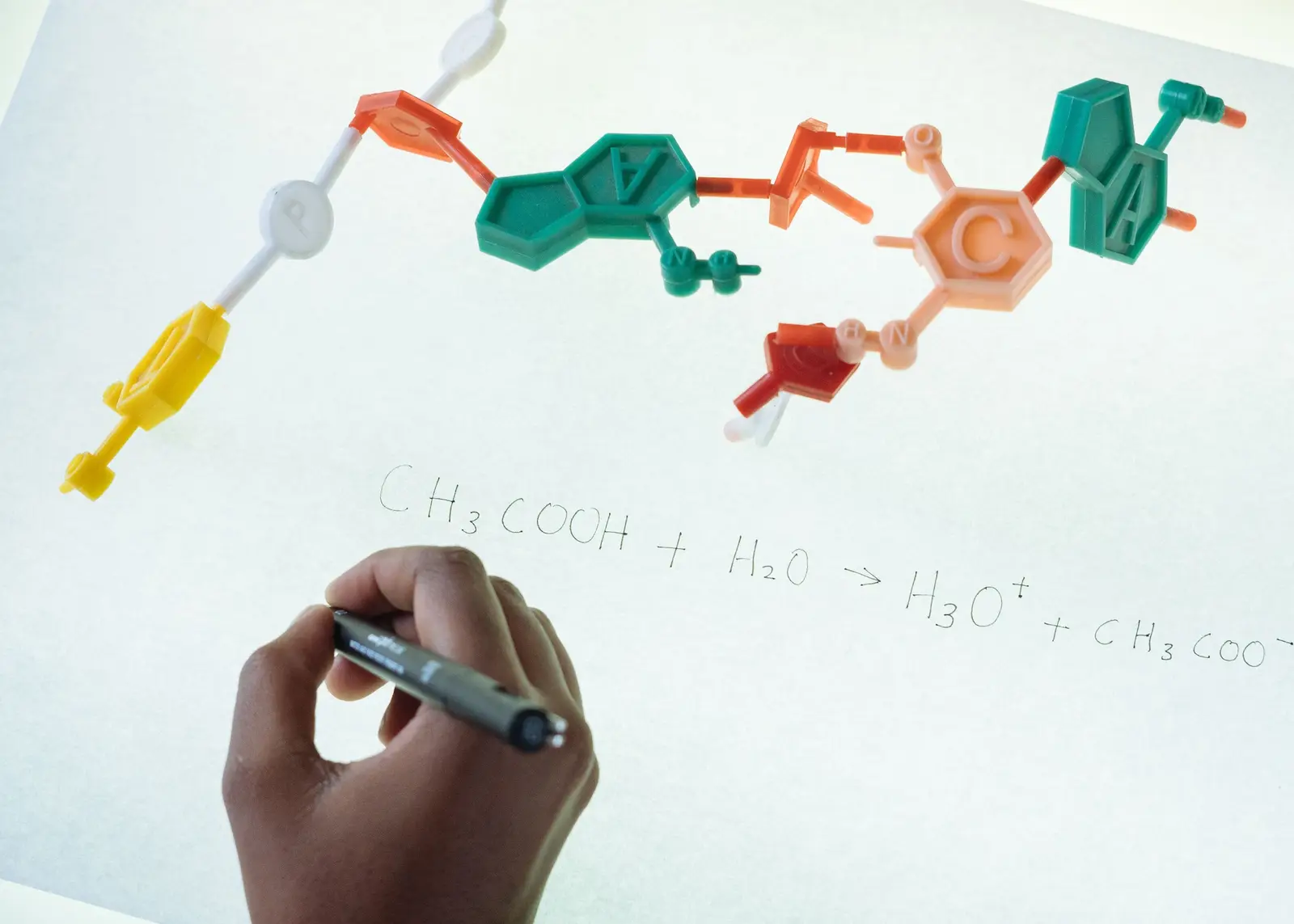
AI can identify drug candidates in the reading-and-explaining sense, and it does that part well. On MedChemBench, a 99-problem test OpenAI published on November 20, 2026, the best model at the highest reasoning setting earned 84.5% of the available credit. The part it does badly is the part that decides what gets made: choosing between compounds, and predicting their measured properties as numbers.
That split is the whole story. A model that can rebuild a molecule from a description and explain why one analogue beat another is useful to a chemist. A model that guesses human microsomal clearance badly is a hazard if you trust the guess.
What MedChemBench asks a model to do
The benchmark is 99 problems drawn from 117 papers and patents, covering 761 distinct molecular structures. Each prompt stops at a decision point in a real research program: the biological target, the team's goals, the compounds studied so far, and selected experimental findings. Whatever happened after that point is withheld and used to grade the answer. The model reasons forward from the same evidence a chemist had, without seeing how it turned out.
Integrated lead selection is the biggest category at 48 tasks. Structure-activity relationship forecasting has 26. Smaller groups cover ADME and delivery, molecular design and enumeration, safety and liabilities, retrosynthesis, and assay biology and mechanism. Eighty-five tasks cross more than one content domain, because a lead compound has to be potent, selective, absorbed, stable and safe at the same time. Everything here is preclinical. Trial design and regulatory work are outside it.
One problem involves PRMT5, a protein studied in cancer drug discovery. The model has to reconstruct three related compounds and then predict cellular potency, permeability, efflux and human microsomal clearance. Four numbers from one molecule, and doing well on one of them says little about the next.
The scores, and a number that doesn't match
At the xhigh reasoning setting, OpenAI reports GPT-6.2 Astra at 84.5% of available credit, GPT-6 Astra at 83.3%, GPT-6.1 Sol at 82.0% and GPT-5.6 Sol at 58.2%. A Crypto Briefing write-up of the same benchmark gives a different picture: GPT-6 Astra at 49.7% and GPT-5.6 Sol at 48.3%, described as the top of the leaderboard as of late November 2026, with nothing clearing half.
Both can be reported accurately without describing the same quantity. "Share of available credit" reads like partial credit summed across multi-part answers. A leaderboard percentage is more likely a stricter pass rate. The published material does not explain the conversion, and I can't reconcile the two from what's out there. What survives the discrepancy is the size of the gap between model generations, roughly 24 points, whichever way you count it. That gap is the more trustworthy signal.
Where the models are strong, and where they fall over
GPT-6 Astra was strongest at reconstructing molecular structures and explaining experimental evidence. It was weakest at selecting compounds and predicting their numerical properties. Compound selection is the largest category in the benchmark, 48 problems out of 99, and property prediction is the output that feeds a synthesis queue.
Writing a persuasive explanation of why compound A beat compound B is a language task, and language tasks are where these models live. Estimating clearance within a range that changes what you make next week is a measurement task. Benchmarks that average the two produce a number that flatters the first and hides the second.
Wet-lab data is messier than a paper figure
Published gel images are the ones that worked. BioBasicsBench, built with the enzyme design company Ligo, uses raw experimental evidence instead: gel images, colony plates, microscopy and instrument readouts, including the failed and ambiguous ones. Its 100 tasks cover protein methods, imaging and cytometry, quantification and assays, nucleic acid methods, and molecular cloning, from reading a DNA sample's molecular weight off a gel to troubleshooting an assay whose controls don't look right.
At xhigh, GPT-6 Astra averaged 66.7% of available credit against 43.8% for GPT-5.6 Sol. The benchmark's framing is the useful part: it checks whether an agent recognises when the evidence cannot support a conclusion. Misreading an image or missing a bad control sends a lab down a path that answers nothing, which costs more than a wrong score on a leaderboard.
OpenAI grades its own homework
MedChemBench is an internal benchmark. OpenAI built it to evaluate and refine its own models, and its own models sit at the top. The tasks come from published research, which helps, but the scoring choices, the prompt format and the reported metric all belong to the vendor. Independent replication would be the thing to watch for, and there isn't any in these sources.
The surrounding family is also OpenAI's: LifeSciBench, launched around June 2026 with 750 expert-authored tasks across seven workflows, and GeneBench. One reported result says GPT-Rosalind improved on drug-discovery metrics compared with base GPT-5.5 models following evaluation on MedChemBench. If a model is tuned against a benchmark, its score on that benchmark stops measuring much, so treat that particular result carefully.
What has actually been run at the bench
One case in the sources goes past scoring. In June 2026, OpenAI worked with Molecule.one to deploy GPT-5.4 in running 10,080 reactions aimed at improving yields. That is a real chemistry number, and it is also the limit of what the sources document. Earning 84.5% of available credit does not mean 84.5% of a drug program. Candidates still have to be made and tested, and the model's output is a proposal in a queue.
How I'd use this on a chemistry team
Put the models on the work they are measurably good at: reconstructing structures from descriptions, summarising assay evidence across a compound series, flagging which properties are in conflict, drafting a synthesis route to argue about. Keep them away from anything that produces a number a chemist will act on without checking, especially clearance, permeability and potency predictions.
There is no subscription to evaluate here, since a benchmark isn't a product. You're really deciding whether to pay for whichever model you already use for this kind of work. If you're uploading structures or assay data to a hosted model, check the retention and training settings first. Compound structures are the kind of IP that leaves a company quietly.
This is general information about published benchmark results. A real drug program needs a medicinal chemist reading the output, and the sources give no reason to think otherwise.
6.5 / 10
$0
Best for Chemistry and biotech teams that want a model to reconstruct structures, compare compounds and summarise assay evidence.
Pros
- Tasks come from real papers and patents, with later results withheld for grading
- Covers the messy tradeoffs chemists actually manage, including 85 tasks that cross domains
- The companion wet-lab benchmark uses raw gel and plate images rather than published figures
- Clear generational gap between GPT-6 family scores and GPT-5.6
Cons
- Built and scored by the vendor whose models top it
- Weakest in compound selection and numerical property prediction, the two outputs that matter most
- Two published score sets (84.5% and 49.7%) that don't reconcile
- Preclinical only, with no independent replication in the sources
A decent yardstick for the reading half of medicinal chemistry and a weak one for the deciding half. Use models to reconstruct structures and explain evidence; keep a chemist on the compound selection.
FAQ
- Can AI identify drug candidates on its own?
- No. It can propose structures, rank compounds and explain evidence, but someone has to synthesise and test them. In the one lab deployment the sources describe, GPT-5.4 helped run 10,080 reactions aimed at improving yields, with chemists doing the work.
- What is MedChemBench?
- A 99-problem benchmark OpenAI published on November 20, 2026, drawn from 117 papers and patents with 761 graded molecular structures. It covers preclinical tasks: structure reconstruction, lead selection, property prediction, retrosynthesis and assay reasoning.
- What did GPT-6.2 Astra score on MedChemBench?
- 84.5% of available credit at the xhigh reasoning setting, according to OpenAI. A separate report puts the leaderboard's top score at 49.7% for GPT-6 Astra, which suggests a stricter metric. Both figures come from the same release.
- Is MedChemBench an independent test?
- No. OpenAI built it, OpenAI's models lead it, and the company uses it to evaluate and refine those models. The problems come from published research, but the scoring and reporting choices sit with the vendor.
- Can AI read gel images and colony plates?
- Partly. On BioBasicsBench, built with the biotech company Ligo, GPT-6 Astra averaged 66.7% of available credit at xhigh against 43.8% for GPT-5.6 Sol. The tasks use raw lab evidence, including failed and ambiguous images.
- Does MedChemBench cover clinical trials?
- No. It stops at preclinical discovery: potency, selectivity, absorption, metabolism, safety liabilities and synthesis routes. Clinical development and regulatory work are outside its scope.
Sources
More tools worth a look
Is ChatGPT Enterprise worth it at $1 for 2 million federal staff?
Two Japanese financial firms ran ChatGPT Enterprise pilots and published the ROI: 954% and 203%. What those numbers measure, what they leave out, and who should skip the upgrade.

AI in universities: what students get and what it costs
Universities use AI for lesson planning, student support, assessment rules and admin, mostly through ChatGPT Edu licences. Surveys put weekly student use at 81% and pricing stays unpublished.
What Anthropic's IPO means if you pay for Claude at work
Anthropic listed on Nasdaq last Thursday with a safety-first pitch and roughly $900 billion of future compute bills. What its governance can protect, and what Claude buyers should check.